
status 2025 - Annual Report of the Volkswagen Foundation
In 2025, the Volkswagen Foundation was once again able to support promising ideas within the German research landscape with a total grant allocation of 310 million euros. Here you will find all the figures, data and facts from our 2025 Annual Report.
At a glance: The most important figures, data and facts
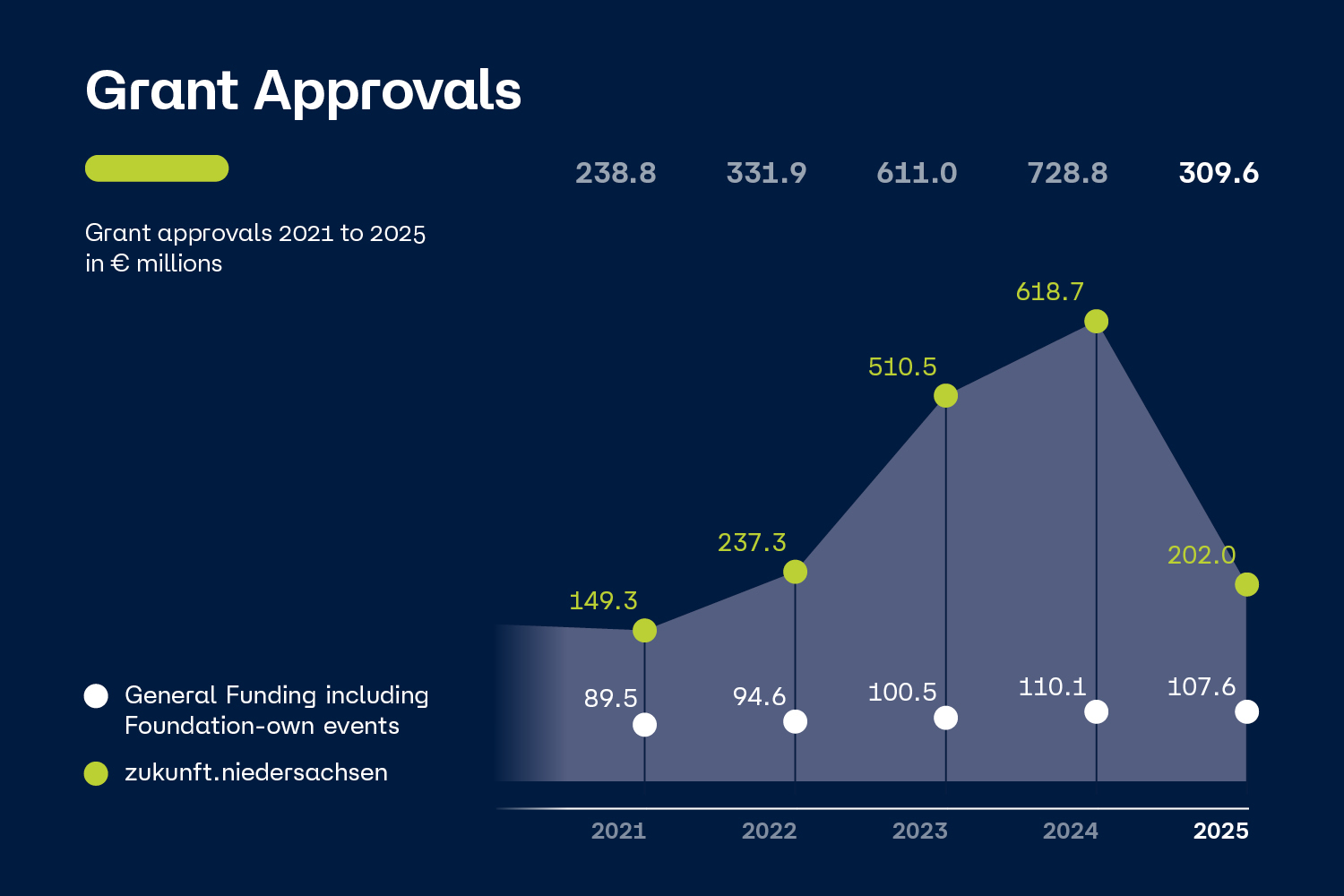
Grant approval totals for the years 2021 to 2025 in general funding (including the foundation's own events) and in the zukunft.niedersachsen programme
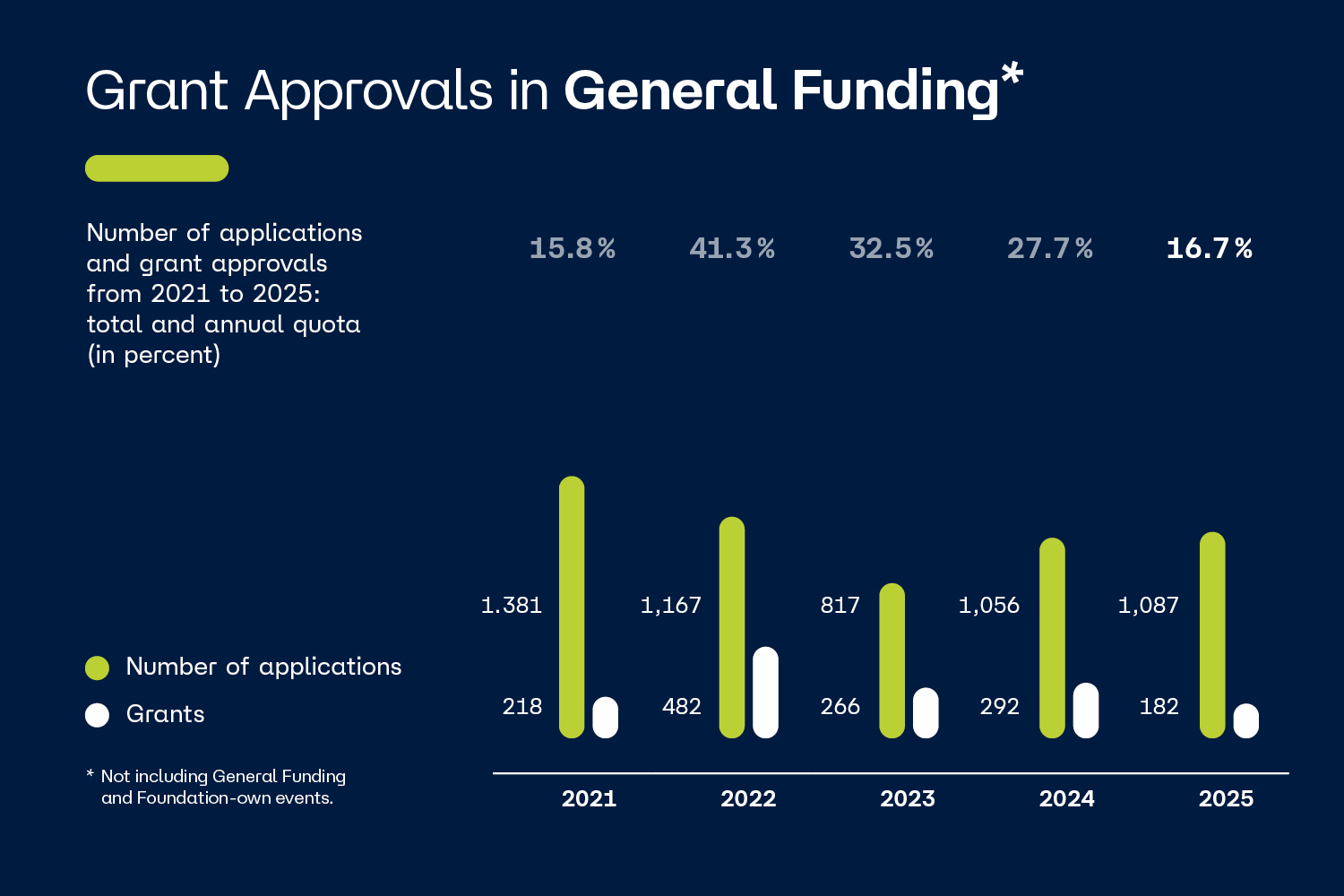
Number of applications and grant approvals (general funding) from 2021 to 2025

Application and approval totals for general funding from 2021 to 2025
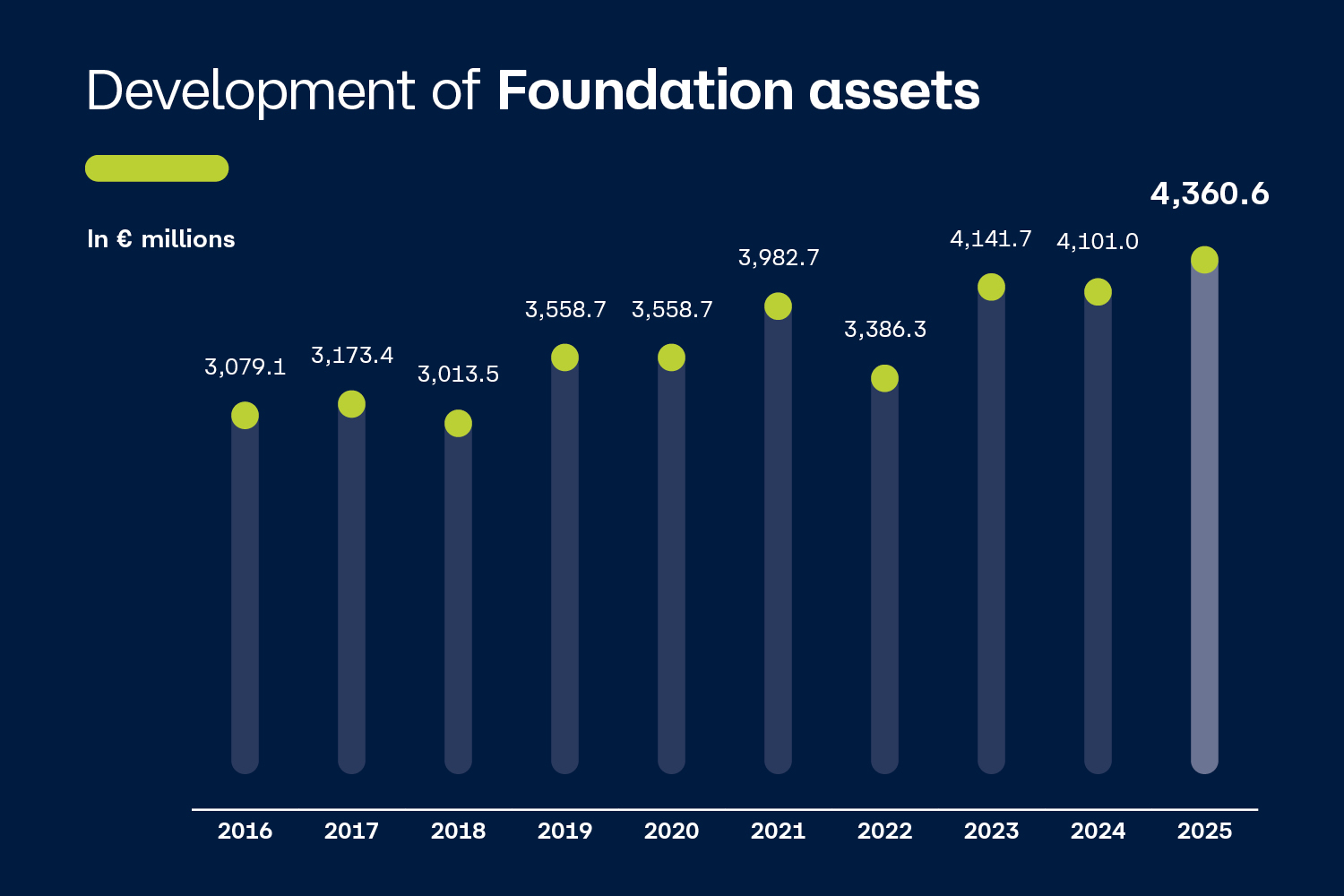
Development of the foundation's assets over the past 10 years

Allocation of assets in the investment portfolio to the asset classes equities, real estate and interest-bearing securities
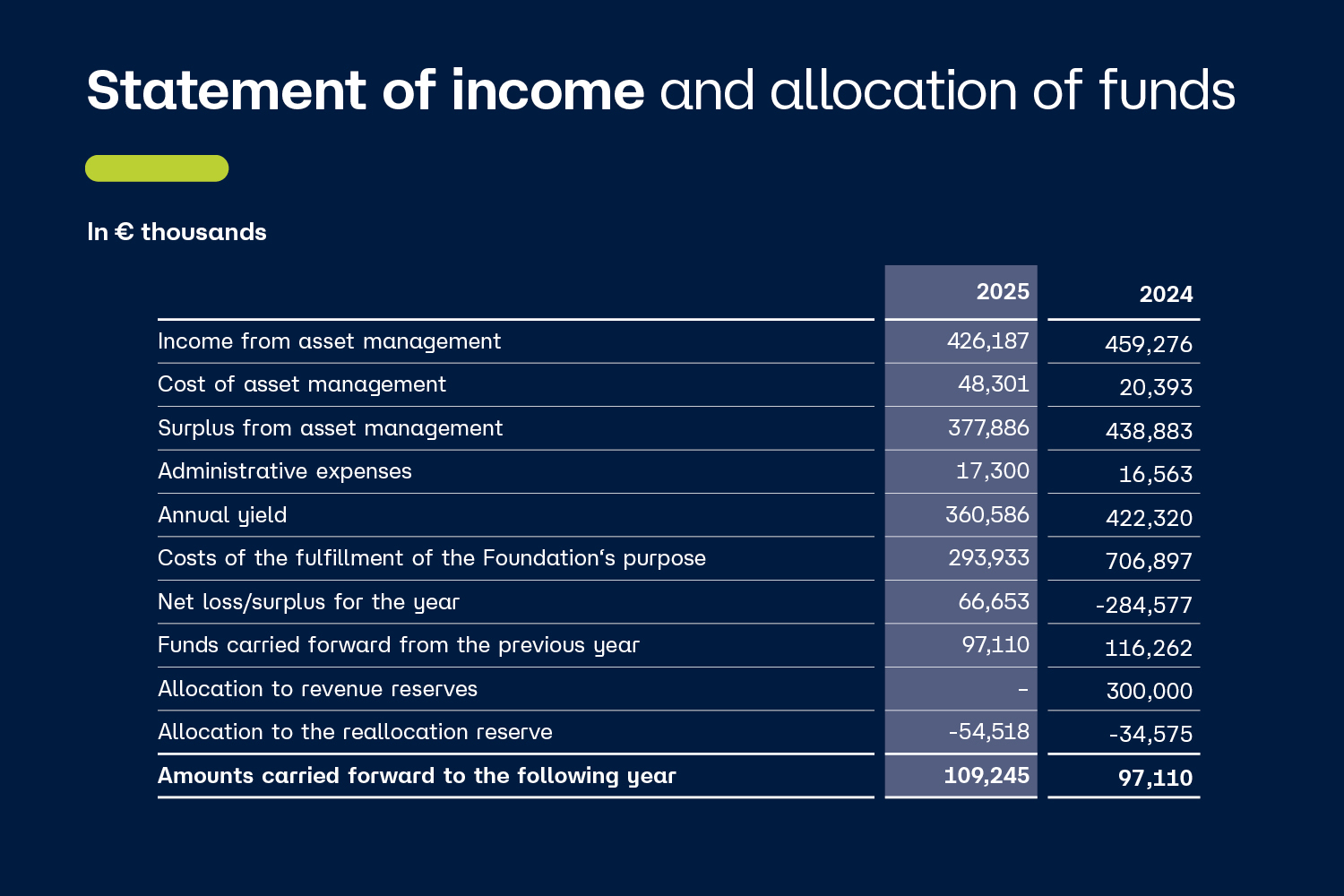
Statement of income and allocation of funds

Balance 2025 - Aktiva
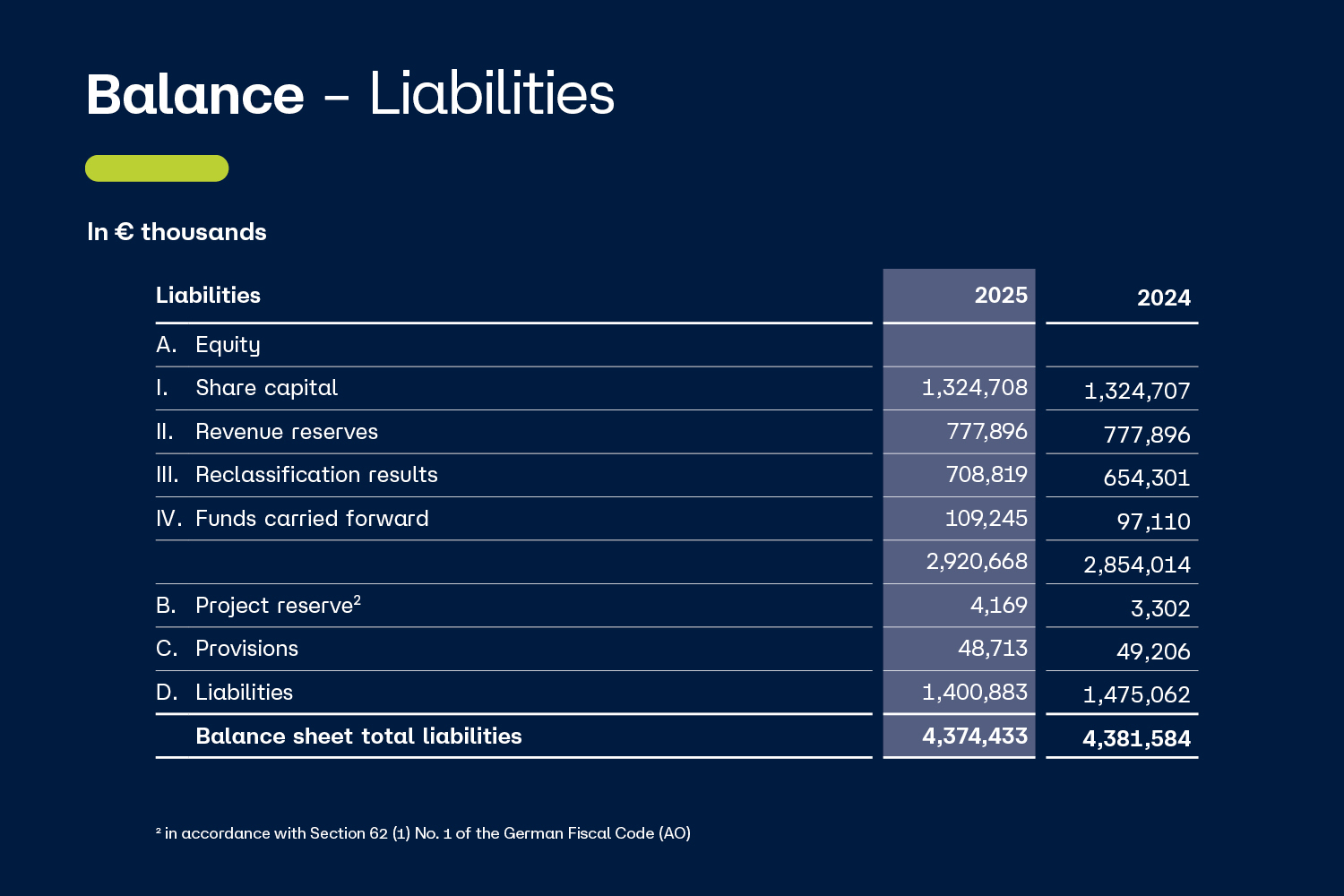
Balance - Liabilities 2025
Audit
The auditing firm BDO AG, Hanover, has audited the annual financial statements 2025 of the Volkswagen Foundation and issued an unqualified audit opinion.

Foundation
The Volkswagen Foundation is the largest private research funding organisation – and one of the largest foundations in Germany. Its purpose is to support research and teaching in the humanities, the social and natural sciences, as well as life and technical sciences. It was established more than 60 years ago by the Federal Republic of Germany and the State of Lower Saxony as an independent, non-profit foundation under civil law. The Foundation has its offices in Hanover.

Capital and Funding
The Foundation capital currently amounts to around 4.3 billion euros. The amount available for funding comes from the investment of this capital and is mainly used for general funding purposes. In addition, there are profit entitlements (mainly dividends) on 30.2 million Volkswagen trust shares held by the State of Lower Saxony. This funding is allocated to the zukunft.niedersachsen programme, which is jointly managed by the Foundation and the Lower Saxony Ministry of Science.

Strategy
The funding portfolio is structured around four profile areas:
- Exploration,
- Social Transformations,
- Understanding Research – Reflecting on and Practice of Science,
- zukunft.niedersachsen.
The Foundation also offers various funding opportunities in the field of science communication.

Funding Concept
The Foundation has developed four guidelines for its funding practices.
- Providing Impetus: The Foundation aims to play a pioneering role by supporting innovative pilot projects.
- Taking Risks: Creating spaces for experimentation – also for talented early career researchers.
- Crossing Borders: Transnational, interdisciplinary and transdisciplinary projects are core features of its funding.
- Shaping Structures: Funding should trigger lasting impact, a goal which the Foundation systematically analyses and pursues with a view to sharing its expertise with others.

Sustainable Investment
The Foundation’s asset management has been taking aspects of sustainability into account since 2011. The entire equity and bond portfolio is continuously monitored to ensure that ESG criteria are met. ESG defines a standard that can be used to assess an organisation’s economic sustainability. The challenge for the Foundation is to achieve the highest possible level of sustainability with its investment strategy – without jeopardising the mandate set out in its statutes, which is to invest the assets as profitably as possible.

Organisation
The Volkswagen Foundation currently employs 115 people, mainly in the three departments of funding, asset management, finance, and administration. Four staff units report directly to the CEO Dr. Georg Schütte, who heads the Foundation. The supervisory and control body is the Supervisory Board, which comprises 14 individuals from academia and other areas of society.

zukunft.niedersachsen
With a joint funding programme the Volkswagen Foundation and the state government of Lower Saxony aim at promoting research, education and transfer in Lower Saxony. The aim of zukunft.niedersachsen is to make the state significantly more visible as a centre of science in the context of domestic and international competition. The focus is on quality-assured selection processes and the ongoing identification of future-oriented fields of research. Three priority areas are currently being specifically promoted: digitality, transformation, and cutting-edge research.

History
The Foundation owes its existence and its name to an agreement between the Federal Republic of Germany and the State of Lower Saxony concluded in 1961. The Foundation was subsequently established with proceeds generated by the privatisation of the Volkswagen manufacturing company. With seat in Hanover, it started operations in 1962 as an independent, private and charitable foundation under civil law – and not as a corporate foundation.


Foundation News
Defending academic freedom
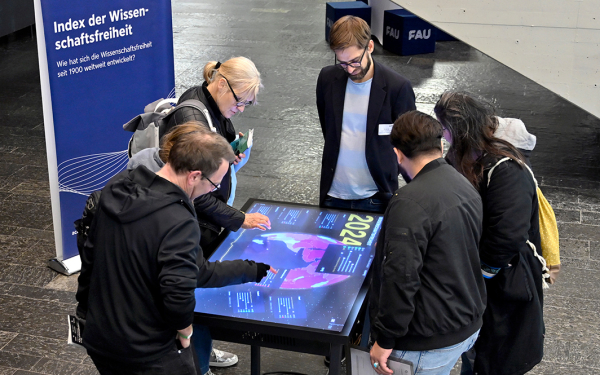
As a major funder of research, the Volkswagen Foundation sees it as its responsibility to strengthen the resilience of the academic system in the face of multiple challenges. One tool for achieving this is project funding, such as that provided for the Academic Freedom Index (since 2021), which measures the level of academic freedom worldwide every spring and has identified a dramatically accelerating decline. Another tool is events such as the high-profile panel of experts focusing on ‘Academia under attack’ at the international science event Falling Walls in Berlin. The Foundation will continue to be active on this topic in 2026.
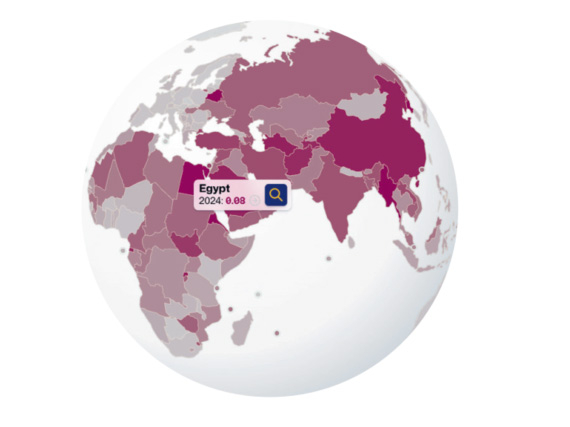
The level of academic freedom is rated on a scale of 0–1. With a score of 0.08, Egypt ranks among the lowest.
New funding offers (2025)
- Researching Research: Strengthening University Centres
This funding opportunity aims at supporting centres for research on research in the area of developing a forward-looking strategic concept. - Navigating a Transforming World Order: Fellowships on Security and Technology
This call for applications is aimed at earlycareer postdoctoral researchers conducting research on the nexus of security and technology from a European perspective. - Transatlantic Bridge Professorships
This funding opportunity is aimed at internationally renowned professors in the humanities and social sciences who are currently based in the USA and wish to work in both the USA and Germany. - Transformational Knowledge on Democracies under Change – Transdisciplinary Perspectives
This funding offer is currently under review. Last closing date for applications was 9 September 2025. - Impetus for the German Science System: Strategic Experimental Spaces – University Development Requires Flexibility
Applications are no longer being accepted. Last closing date for applications was 30 September 2025. - Theme Week “Multiple Crises – Strained Resources”
Researchers from the field of economics and related sub-disciplines discuss the decline in financial, material and human resources in society and develop potential solutions. (Call for proposals closed; next theme week in April 2026.)
Innovation Council Lower Saxony
How can good ideas be put into practice more quickly? This is the question the Innovation Council Lower Saxony wishes to address. Eleven international experts are examining the state of Lower Saxony from an external perspective: Where do its strengths lie, where is bureaucracy holding things back, and where are new opportunities emerging? The council was appointed by the state government for a period of 18 months. It is chaired by Georg Schütte, Executive Director of the Volkswagen Foundation. In the summer of 2026, the Innovation Council will present ist recommendations on how cooperation between science and research, business and politics can be made more productive in order to strengthen Lower Saxony as a hub for Innovation.

Kick-off meeting of the Innovation Council in July 2025
New funding offers zukunft.niedersachsen (2025)
- Lower Saxony – Scotland Research and Innovation Scheme: Stream II – Excellence Track
The programme offers researchers from Lower Saxony and Scotland the opportunity to prepare external funding applications for joint Research projects (particularly in the scope of Horizon Europe). - Hannah Arendt Fellowships
The Hannah Arendt Fellowships enable outstanding international researchers from the humanities, cultural studies and social sciences to undertake six-month Research stays in Lower Saxony. - AI Research Groups Lower Saxony
Artificial intelligence is of central importance to Lower Saxony’s research system. The call for proposals combines the objectives of individual researcher funding with the further development of AI methods. - Campus International – Pilot projects
to attract international students In order to help ensure a supply of trained specialists and to enhance the academic diversity and performance at universities in Lower Saxony, support is provided for Pilot projects aimed at attracting international students.