Inken Dworak-Schultz
Fabien Schultz is searching for natural materials that can be used to treat mental health conditions. To this end, he is working with indigenous communities in Uganda and Tanzania – and with monkeys.
There was this sorceress, the village's spiritual healer. She was solemn and didn't say a word, simply staring intently at Fabien Schultz, with the assembled village council behind her. She walked slowly around the researcher, who, despite his optimism, was now beginning to feel nervous. A foreigner, a white man, who had come to this Ugandan village to document the people's traditional knowledge. Schultz was fully aware that the woman had every reason to be sceptical. He had made contact with indigenous communities dozens of times before, having them show him and explain medicinal plants. Only his request had never been as specific as this time. He asked about substances that bring happiness, cause hallucinations or alleviate fear. Substances that can alter consciousness. The knowledge he was seeking from her could be illegal for her – they both knew that. Schultz had to convincingly convey that he would protect his informants; he had to win her trust. And if he failed this test – the nature of which he didn't even know – then a large part of his new research project would be over before it had even begun.
The woman scrutinised him intently. But finally she turned to the assembled crowd and spoke the redeeming words. He could be trusted, she declared: she could see it in his eyes.
"And I just thought: Phew!" says Schultz, letting his tense shoulders drop as if he had just come through the silent interrogation once again. This time he is sitting in his office at the Bernhard Nocht Institute for Tropical Medicine in Hamburg. Outside the window, heavy cargo ships chug along the Elbe, whilst the spring sun melts away the last patches of snow.
New medicinal plants for research
Schultz is an ethnopharmacologist. He works with plants and other natural materials that indigenous communities in Africa have traditionally used for medicinal purposes. Very few of these materials have ever been studied using modern research methods.
In his current project, "SpiriPharm", which is funded by the Volkswagen Foundation as part of its initiative "Pioneering Projects – Exploring the Unknown Unknown", he is focusing on neuroactive substances used in rituals, but also for the treatment of mental health conditions.
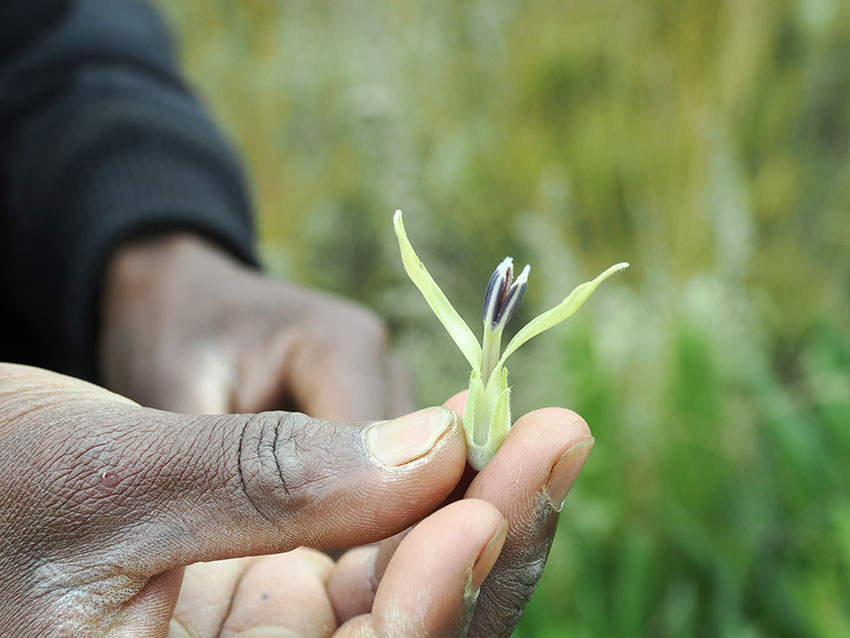
Locals point out plants with healing properties to Schultz.
Much of this remains undocumented to this day, yet this knowledge is rapidly disappearing: it is mainly older people who possess it. Furthermore, through his basic research, Schultz also aims to lay the groundwork for new medicines to treat mental health conditions.
We are detectives in the Forest Pharmacy.
Schultz and his team interview people in Uganda and Tanzania, collecting plants, insects and fungi in the process. They take the material to laboratories at the Hamburg Institute of Tropical Medicine and Neubrandenburg University of Applied Sciences, which Schultz uses for his analyses. Here, his team carries out an initial chemical analysis of the remedies and investigates the potential pharmacological effects of the materials. This provides them with clues as to which ingredients have medicinal properties. "We are detectives in the forest's pharmacy. We follow clues to potential remedies," says Schultz.
But his findings are not based solely on human knowledge and laboratory analyses. Schultz also works in zoopharmacognosy: he observes which natural remedies animals use to treat themselves. In doing so, he has discovered astonishing behaviours. Chimpanzees, for example, only eat the bark of certain trees when they are plagued by parasites or inflammation. Or elephants, which specifically seek out certain herbs when they are suffering from injuries or diarrhoea. "We are often the first to document such behaviour at all," he says.
The self-medication of chimpanzees was first observed back in the 1960s by Jane Goodall. The world-famous primatologist remained a mentor and collaborator to Schultz until her death. In Gombe Stream National Park, which owes its existence to Goodall's work, he too now studies wild chimpanzees for his research within the SpiriPharm project.
In the right place at the right time
Even as a child, he wanted to study animals and nature one day, Schultz explains. That this is actually how things turned out is, for him, a stroke of luck. Just as he generally describes the remarkable development of his scientific career as a chain of fortunate circumstances.
Biology was what interested him most at school. And sport. However, tuition fees, which were introduced at many universities in the early 2000s, narrowed his higher education options, as he was the first and only member of his family to go to university.
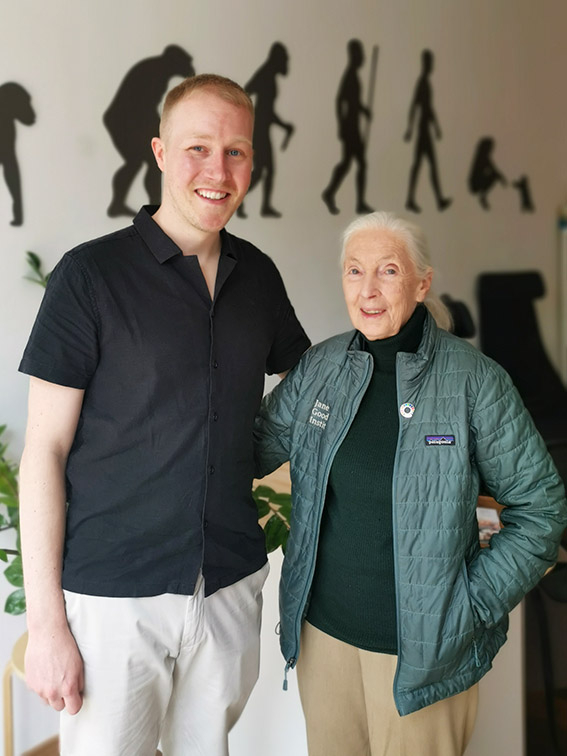
Fabien Schultz and the world-famous primatologist Jane Goodall.
He opted for Bioproduct and Food Technology in Neubrandenburg: a relatively small university of applied sciences with no tuition fees, but all the more opportunities to make up for it. The laboratories on site were modern and available for him to use freely; he still uses some of them for his projects to this day. His research group leader and supervisor supported his innovative research ideas from the very start and gave him free rein. Schultz met leading international researchers in ethnopharmacology at conferences; many became his mentors. "I just always met the right people at the right time," says Schultz today.
A fateful encounter in the canteen
Perhaps the most important moment back then was that day in the canteen, which was to set his compass needle pointing towards Africa. Schultz wanted to study for his Master's degree in an English-speaking country abroad, but once again he lacked the necessary funds for tuition fees in the USA, the UK or Australia. By chance, on that day he met a delegation from Kampala University in Uganda, who were visiting the university and joined the queue behind him at the food counter. They struck up a conversation, whereupon the head of the delegation invited him to his country. And Schultz went. He travelled to Kampala with his girlfriend at the time – now his wife – got to know the country and its people, and forged connections that still exist today.
His field of research ultimately emerged from his expertise in bioproduct and food technology, his interest in nature, and his personal approach to engaging with strangers in an open and genuine manner. Today, Schultz heads his own early-career research group and has received numerous international awards for his research. In a database, he and his team have so far compiled a total of around 600 extracts from more than 150 plant, insect and fungal species traditionally used for medicinal purposes from all over the world. Their applications range from minor wounds, inflammation and pain to the treatment of parasitic infestations and other infectious diseases. Now, remedies for mental health conditions are set to be added.
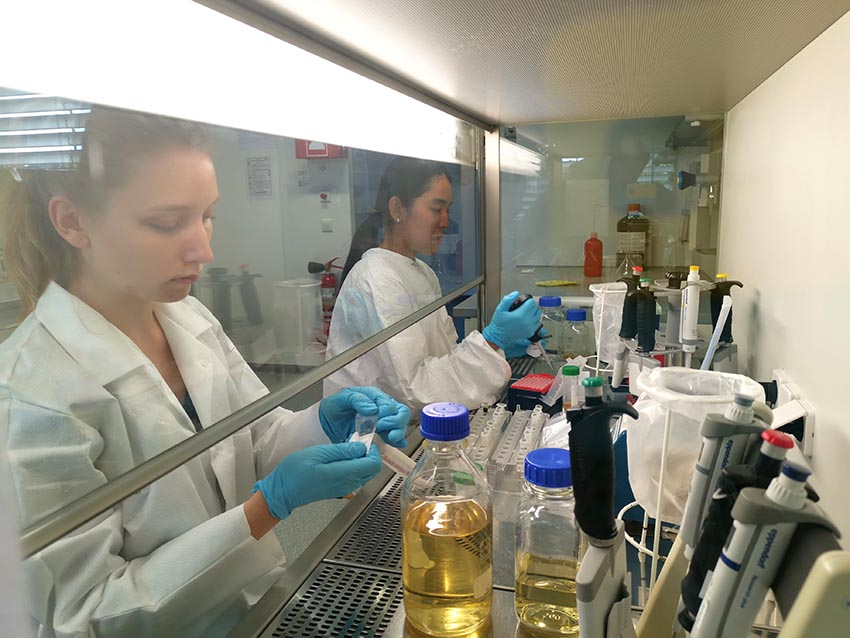
Two female scientists are examining the plant samples on behalf of Fabien Schultz to identify potential medicinal compounds.
Taboo knowledge
SpiriPharm builds on Schultz's earlier research – yet it presents him with entirely new challenges. "For one thing, mental health conditions are much harder to validate than other physical problems," he says. Above all, however, his work is highly sensitive within indigenous societies in tropical Africa. For how to heal a person with a mental illness, how to cure forgetfulness or despondency: all of this often falls here into the category of 'good or evil magic'. Schultz relies on people who are trained in spirituality or traditional healing arts. They are often regarded as witches, shamans, or magicians – just like that woman who pierced him with her gaze. And to this day, these people generally speak of their knowledge only in secret.
The former colonial powers are to blame for this. When they sent out their missionaries, the latter literally demonised everything that did not conform to the Christian faith. In Uganda, which was a British protectorate from 1896 to 1962, the colonial government enacted the 'Witchcraft Suppression Act' in 1957, which imposed severe penalties on all spiritual practices – whether they involved esoteric rituals or the use of medicinal plants with mind-altering effects.
The law remains in force to this day. For local people, it continues to push the knowledge of witches and healers into the shadows. For researchers like Fabien Schultz, it hinders communication and the transfer of knowledge. "A lot of it still happens behind closed doors," says Schultz. "If people were to talk openly about it, they would be breaking the law." No wonder, then, that local people view him with scepticism. Nevertheless, he and his team have been successful: so far, they have interviewed more than 100 local people and, as a result, compiled a list of around 200 potentially psychoactive plants used in rituals or to treat mental health conditions. They have even managed to document a few fungi and three species of insect. "Despite all the difficulties, we hadn't expected such a large number," says Schultz with satisfaction.
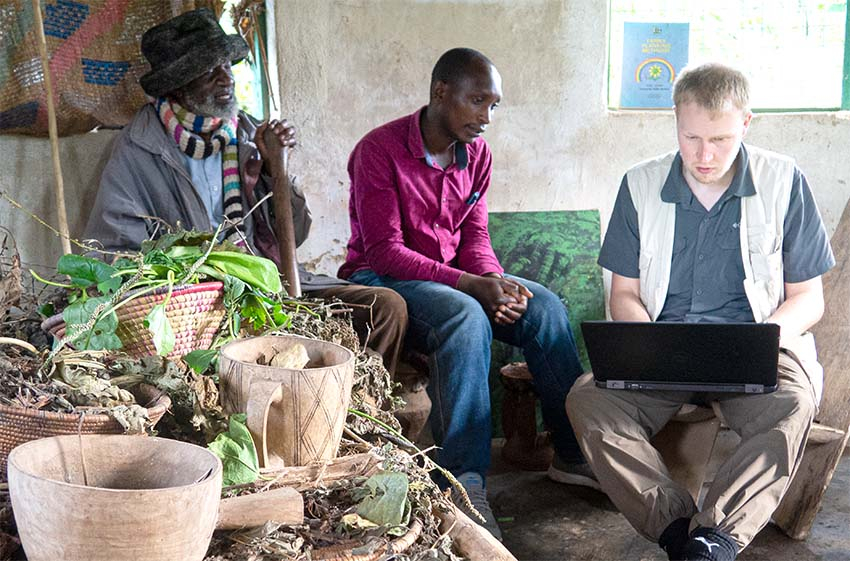
Fabien Schultz is putting into writing what has been passed down orally among the local population for generations.
The next step is to conduct pharmacological tests on the materials and thus scientifically substantiate their effectiveness. Schultz and his team will then return to the study sites and share the new findings through workshops in the local communities. And that's not all: in each of his projects, Schultz first asks the local people what knowledge or measures would help them in the long term. He then initiates programmes to meet precisely these needs – thereby creating a mutual benefit-sharing arrangement, as envisaged by the Nagoya Protocol. Among other things, this international agreement is intended to ensure that indigenous communities also share in the benefits of research findings. For Schultz, adhering to it is a matter of course: "Knowledge transfer," he says, "is not a one-way street for me."