Basic Research: Exploring the unknown
#Basic Research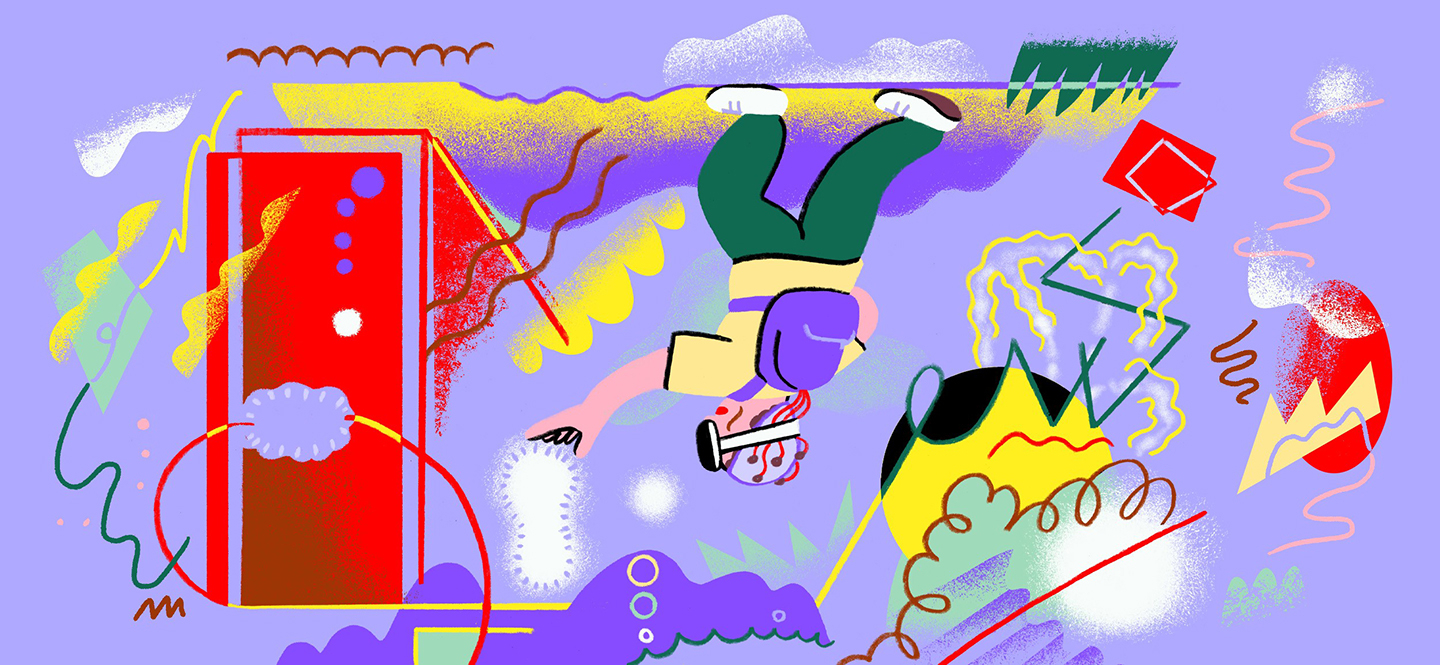
Kati Sziylagi für VolkswagenStiftung
What happens in the brain when we are confronted with completely unknown things and situations? At TU Dresden, Christian Beste is researching what is known as the "unknown unknown". To do so, he is turning science on its head.
Imagine you are standing in a room, just a few square meters in size. There is a door, but it is locked. The room contains objects: on the floor, on the walls, floating in mid-air. Nothing you could name, but rather shapes, structures, things that seem completely unfamiliar to you. You reach for a red object. It flies upwards; at the same time, the green thing falls downwards. The objects appear to exert an influence on each other—but you don"t know by what logic. How on earth are you going to get out of here?
This is not an escape room. Nor is it an art project. This is a scientific experiment.
Christian Beste, professor of cognitive neurophysiology at TU Dresden, explores one of science´s most unsettling questions: How do we react to situations that lie outside our experience horizon? His focus isn´t on the classic knowledge gap, but on something far more radical.
The Knowledge of Not Knowing
To understand what Beste is researching, a brief foray into epistemology—the study of knowledge—is helpful. There is the known unknown: I know that I have no idea about quantum physics or Swahili grammar. There is the unknown known: things I actually know but am not aware of. And then there is the unknown unknown: those knowledge gaps I don"t even know can exist because the situation itself has never actually arisen before.
In its program with the title "Pioneering Research – Explorations of the Unknown Unknown", the Volkswagen Foundation supports research into precisely such "blank spaces". It supports researchers like Beste who put forward visionary ideas rather than a traditional research question, and are prepared to accept the possible failure of such risk-prone research.
When Beste first came across the Volkswagen Foundation´s call for proposals, he was initially at a loss to come up with a research idea. "The unknown unknown—how was one supposed to research that?", he says. Some of his colleagues even poked fun at him: Did he perhaps want to submit a blank sheet of paper? Then, in the course of his literature search, Beste kept coming across the same historical reference: Chernobyl. Precisely how to cope with the nuclear disaster of 1986 was completely beyond the imagination of the time. There was no established procedure, no blueprint. The engineers and rescue teams were highly skilled and had a repertoire of possible courses of action, but they were to find they were totally unprepared for what was actually happening.
Science is always understood as a very precise, rational process. But it isn`t.
Beste believes to have found a possible approach where one might least expect it: in infancy. You could say that the neurophysiologist had come full circle. After all, his professorship is anchored in the Department of Child and Adolescent Psychiatry.
The researcher and his question
For anyone who truly wants to understand the unknown unknown must go all the way back to the beginning. There is a moment in every person"s life that is fundamentally shaped by a major happening: birth. A newborn knows and can do nothing. It finds itself in an unknown unknown situation. Bit by bit, it begins to make sense of the world. It reaches for the mobile above its crib and realises that it moves. It learns, understands if-then relationships, recognises connections.
The problem: Adults cannot simply restore this openness or naivety. The neural network of experiences, expectations, and learned patterns is too dense. The best research approach is therefore what the Dresden neuroscientist calls "functional regression": The subjects must be placed in a state in which their repertoire of actions is literally suspended, allowing them to develop something akin to childlike curiosity.
And with that, we find ourselves back in that strange room. The virtual reality lab that Beste`s team has set up at TU Dresden is not a science fiction scenario, but a carefully constructed research tool. The test subjects put on VR goggles. They stand on a carpet that makes the boundaries of the virtual space palpable. And they find themselves confronted with objects for which there are no names.
The goal is clear: the door must be opened. Just as it was clear that the reactor disaster had to be contained. The path to that goal: completely unknown. The test subjects have nothing familiar to fall back on. No tool serves a recognisable function; no object does what one would expect of it. There is a solution, but it follows no logic that one has ever learned. "The key is distributed across different objects that have different properties, which one also does not immediately recognise," explains Beste. "What one has learned no longer works."
Reading the EEG in reverse
While the test subjects feel their way around this room, Beste"s team records their brain activity. Using an electroencephalogram, or EEG for short, they record the signals that nerve cells send in this unfamiliar situation. But how do you interpret data when you don"t even know what to look for?
In traditional brain research, the process goes like this: Researchers know that a person is reacting to a stimulus and then examine the EEG at that exact moment. Beste has simply flipped this approach on its head: His team looks for unusual patterns or outliers in the EEG signal and then tries to link them to specific moments in behaviour. "I look at EEG data to understand what might have happened in the brain," says Beste. "This is a completely different ballgame, since the standard methods we use to analyse brain activity data no longer work."
Basic research—and where it leads
What Beste is doing is basic research in its most extreme form: there is no immediate practical application, no technology to be tested by the end of the funding period. Rather, the goal is to understand what happens in the brain during these moments, which neural mechanisms govern action in conditions of radical uncertainty.
What does his research mean? Perhaps a breakthrough in an entirely new field. Or perhaps his findings will resurface in completely different contexts a few decades from now. Or perhaps not.
One anecdote illustrates the difference from conventional research funding particularly well. When Beste submitted an interim report after the first few months of the project, he did what scientists normally do: he listed results and progress. The Foundation replied: Thank you, but an inventory is sufficient; there is no need for a showcase of achievements.
This really makes sense. After all, a project like this doesn"t follow a work schedule that you check off month by month. It follows the logic of research itself: tentative progress, detours. In such a process, failure becomes a form of insight. Beste deliberately did not create positions for doctoral students. After all, anyone who invests years in a project that ultimately comes to nothing is left empty-handed when it comes to scientific results. Instead, experienced postdocs work part-time to spread the personal career risk. "I also have a social responsibility toward the people I work with," he says.
I also have a social responsibility toward the people I work with.
Intuition as part of the experiment
And how do you decide what to do next when you don"t have a roadmap? Beste answers without hesitation: intuition. "Science is always understood as a very precise, rational process. But it isn`t," he says. "It has a lot to do with gut feeling and creativity." Anyone working in an unknown field of research first needs the courage to sense a possible new direction—and then develop a method to follow it.
The first results from the VR experiment and behavioural research on mice are expected to be published in 2026. Initial findings are already available: Methodological advances, new approaches to EEG analysis, and animal models. No one knows yet whether this is the beginning of something big or a path that leads nowhere. "But that," says Beste, "is exactly what makes it so exciting."
Editor-in-charge