
Three Years of Scicomm Support: An Interview with Julia Wandt
#Science communication
antonia mathia
Since 2023, Science Communication Support (Scicomm-Support) has been providing support to those facing hostility in the field of science communication. Julia Wandt has been involved from the very beginning and explains what makes Scicomm-Support unique on a global scale and the challenges she faces in her work.
Scicomm Support is the central point of contact for dealing with attacks and unwarranted conflicts in science communication. It was established in autumn 2021 on the initiative of the German Association for University Communication and 'Science in Dialogue', and was incorporated in 2023 into the research network "Capacities and competencies in dealing with hate speech and hostility to science" (KAPAZ).
For a good three years now, Scicomm-Support has been supporting individuals and institutions within the scientific community in dealing with various forms of hostility. What insights did you not anticipate at the start of the project?
Julia Wandt: What surprised me personally is the diversity of academic disciplines that have reached out to us. Of course, we expected to hear from organisations conducting research into socially controversial topics: for example, climate change, gender and diversity, and the COVID-19 pandemic. But we've also had researchers from the fields of philosophy, sports science and even mathematics. If you'd asked me before the project began whether I'd expected this, I would certainly have said no.
It's also interesting how much offline hostility there is — things like threatening phone calls and letters, disruption at events or verbal abuse in the office. Of course, we also face online hate and abuse on social media, but the ratio between online and offline hostility really took me by surprise.
Is it possible to identify who is behind such attacks? And if so, how do the attackers differ?
Unfortunately, there is still little research on this. However, based on our experience in science communication support, we see three groups: Firstly, there are individuals who share a particular viewpoint. These might be people who deny climate change, for example, or who claim there are only two genders. Someone then sends a link to a particular interview or post in a Telegram group and says: 'Come on, let’s meet up there and tear that person to pieces'. Although they don’t know one another, their shared viewpoint nevertheless unites them into a large group.
There are simply organisations and institutions that do not want science communication if, in their view, the findings communicated there run counter to their own interests.
The second group comprises organisations, associations or institutions that pursue specific interests. We had, for example, the case of the agricultural sociologist Janna Luisa Pieper from the University of Göttingen. After she gave an interview to NDR, farmers’ associations, amongst others, contacted her. The reason – and I’m simplifying here – was that she had made statements about the extent to which these organisations are, in some quarters, infiltrated by the far right or the extreme right in Germany. This is the result of her research, and she can substantiate it properly. But, of course, farmers’ associations do not want to hear that. There are simply organisations and institutions that do not want scientific communication if, in their view, the findings communicated contradict their own interests.
Thirdly, there are individuals who perhaps do not always fully grasp the implications of their actions. They may not even realise that they are being hostile towards someone at that moment, or at least that it is not acceptable. However, this is a smaller group.
How exactly does Scicomm Support help in this regard?
The Scicomm Support service covers three levels of content:
- The first relates to communication support. Here, we ourselves, as communication experts, advise on whether and exactly how it is worthwhile to respond to hostile behaviour through communication.
- Then there is the legal level. This includes criminal cases such as insults or death threats, as well as civil law issues such as the right to privacy and the right to one’s own image and speech. For this, we work in partnership with a renowned law firm.
- Thirdly, we provide support on a psychological level in the form of referral advice. This means we offer support from psychotherapists if those affected wish to receive it.
There are three ways to access specific support:
- The most accessible option is the information on our website. Here, for example, you’ll find guides on how institutions or individuals can deal with hostility.
- You can also enquire about our workshops and training sessions – available both online and in person, ranging in duration from one and a half hours to one and a half days. It is not necessary for an incident of hostility to have already taken place; many organisations also request training and workshops for preventative purposes.
- In addition, we offer a personal telephone counselling service. You can call us every day from 7 am to 10 pm, including at weekends and on public holidays.
Is there a charge for Scicomm support?
All our services are free of charge for individuals and organisations seeking support. It is important to us that access to support is not hindered by financial constraints. If I need to defend myself – for example, against platform X because posts have been published there that infringe my personal rights – then it shouldn’t matter how much I earn. Even as a PhD student, for example, I must be able to assert my rights in such situations.
What are the biggest challenges you face?
We’ve grown very large very quickly, in the sense that we receive a huge number of enquiries. We now run four to six training sessions or workshops per week. The volume of telephone consultations has also increased, not only in terms of quantity but also in terms of the nature and scope of the cases.
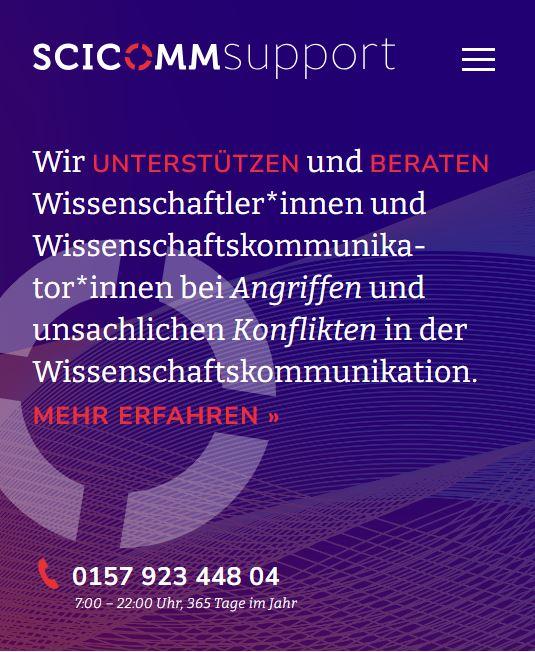
At www.scicomm-support.de, researchers can find guidance documents as well as the helpline number.
I wouldn’t have thought at the start that we would be so well received as a point of contact. This has been made possible thanks to the support of the foundations and funding from the federal budget, but above all because of our many volunteers. We have only one person in a paid position. Everyone else works on a voluntary basis so that as much of the money as possible goes towards supporting organisations and individuals, particularly with legal assistance.
Personally, I’m torn. Of course, I’m delighted that we can help so many people and organisations. It’s also brilliant that we now have a prominent voice in hearings and debates on academic freedom. That’s right at the heart of our expertise, and we’re very happy to do it. On the flip side, however, this high demand also means that we simply face a great deal of hostility.
We face all kinds of hostility: from death threats to physical attacks.
From time to time, the specific cases themselves can also be a challenge. We deal with all forms of hostility: from death threats right through to physical attacks. When you hear the details and realise that we’re talking about incidents at academic institutions in Germany, it can sometimes be quite shocking. On the other hand, however, we also receive feedback from the individuals and institutions affected, expressing their gratitude.
Are there comparable services in other countries?
With Scicomm-Support, we are actually the first point of contact worldwide to provide such concrete support to institutions and individuals. Although there was already a similar organisation in the Netherlands, it is structured more as a scheme to help people help themselves. There are also individual initiatives in the USA, but no support centres offering the same services as in Germany. Because we were the first organisation of this kind internationally, other countries are also contacting us. Sweden and Finland, for example, would like to set up similar support centres, and we’re advising them on this. Just today, Spain has also got in touch as another country.
Precisely because we are only responsible for Germany, Austria and Switzerland, it is helpful to exchange ideas with people from other countries. We are delighted to be able to share our experience in setting up such help centres. This is exactly what we can now achieve with the support of the Volkswagen Foundation: further expanding and strengthening our international network.
What milestones have already been reached in the project?
We began offering telephone counselling in July 2023. More and more organisations then started asking us for workshops and training sessions. We hadn’t planned for these at all to begin with – nor had we realised there was such a great need in this area. Within a few months, we had developed a programme of workshops and training sessions. That is certainly a milestone that has since been added. We also started small with the guidance documents and now update them regularly.
Another milestone: our national and international network. Our thinking was that the issue of hostility in academia can be tackled most successfully if everyone who wishes to support this cause works together. That’s why we began building the network early on, so that we could address this major issue as effectively as possible.
What else is planned for the future?
One area that has already grown significantly in recent months – and will continue to do so in the future – is consultancy at the institutional level. How can we further support academic institutions as a whole in establishing robust resilience structures? This is a key area of focus that is becoming increasingly important, particularly as we look ahead to the upcoming elections.