Tim Kalvelage
Radioactivity is generally considered harmful to life. Yet in manganese nodules in the deep sea, microorganisms might benefit from it. Or even live off it? This is the intriguing hypothesis that geoscientist Walter Geibert hopes to prove.
Tubular structures reminiscent of columns. Next to them, strikingly regular dots; elsewhere, random speckles. "I’ve been working with marine sediment samples for years and am surrounded by experts, yet 30 marine scientists couldn’t agree on what this is," says Dr Walter Geibert, looking at the photograph. "Not even on whether they are traces of life or of non-living matter." Geibert heads the Laboratory of Radiogeochemistry at the Alfred Wegener Institute in Bremerhaven. The image shows a tiny fragment of a manganese nodule.
Manganese Nodules: Valuable Resource – and Habitat
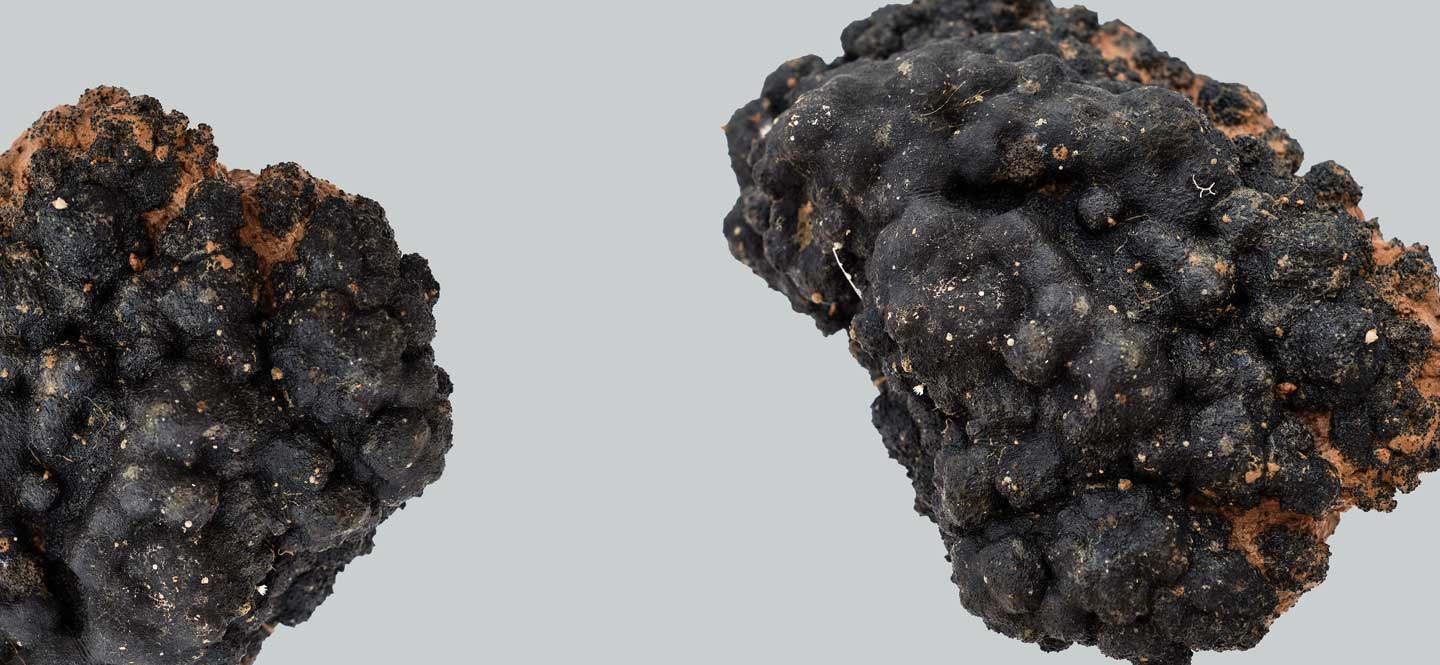
These spherical formations, which can be up to several centimetres in size, lie on the seabed at depths of around 3,000 to 6,000 metres, sometimes packed closely together. They grow extremely slowly — just a few millimetres in a million years — from metals that enter the sea through erosion or volcanic sources. As they contain valuable raw materials such as manganese, nickel, cobalt and copper, they are increasingly becoming the focus of deep-sea mining, with potentially significant environmental consequences. For many, they are therefore primarily regarded as controversial raw material deposits on the seabed.
Walter Geibert, however, suspects they may be something quite different: a habitat under extreme conditions that could yield spectacular insights into possible life in space or the course of evolution.
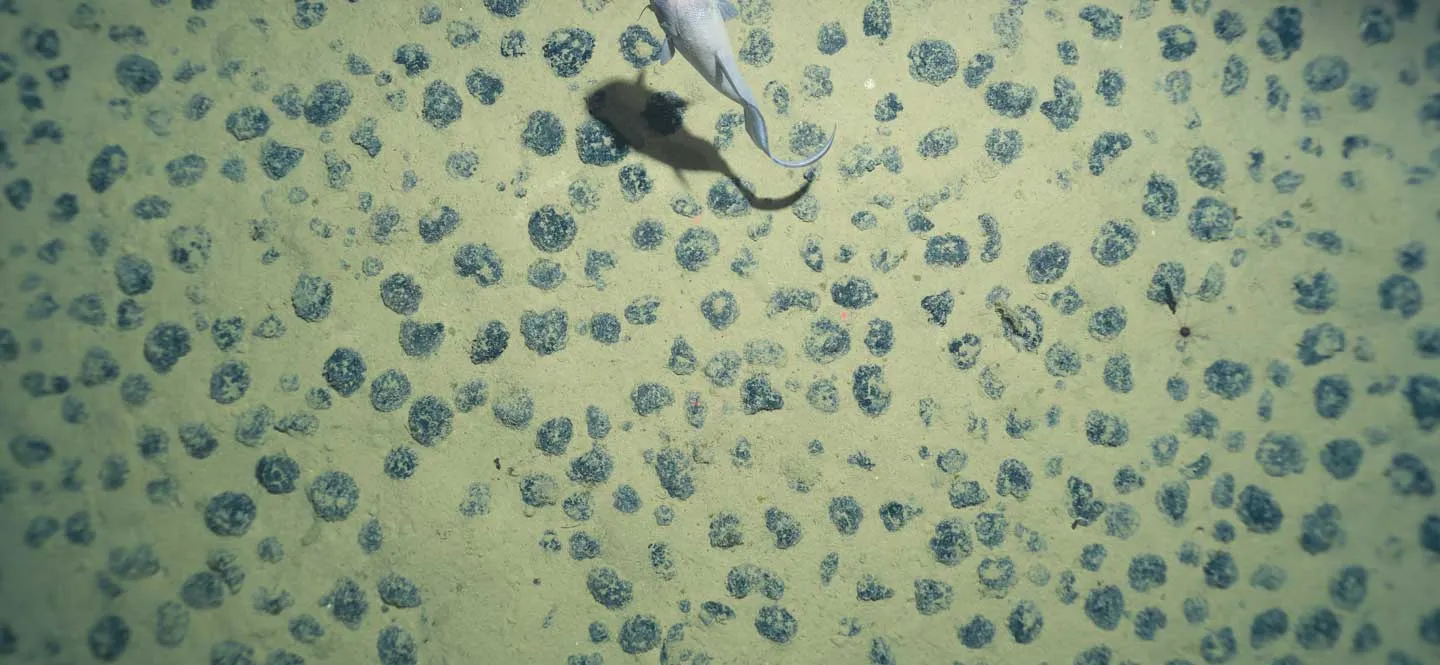
A manganese nodule field in the deep sea: in the beam of a diving robot's spotlight, a grenadier fish (Macrouridae sp.) glides across the flat Pacific seabed, which is strewn with the potato-like lumps of rock.
Unusually High Levels Of Radioactivity
Geibert's path crossed that of the manganese nodules rather by chance a few years ago. The geoscientist has long been studying natural radioactivity in the ocean. "Seawater naturally contains about three parts uranium to one billion parts water. That sounds like a negligible amount, but there are 3.2 milligrams of uranium floating in one cubic metre of seawater. This is very helpful to us: it allows us to trace timescales and transport processes — uranium acts, as it were, as a clock ticking away in the ocean," says Geibert. Whilst working on such an age and time-determination problem, he noticed something unexpected: manganese nodules are significantly more radioactive than the surrounding seawater — by several orders of magnitude. His curiosity was piqued.

Traces of Hidden Life?
For it has already been proven that the radioactive nodules are colonised by microorganisms. Geibert's hypothesis is that radioactivity and life are linked — the radioactive radiation could represent an essential source of energy for the microorganisms. But is this conjecture correct? The geoscientist will investigate this as part of his research funding under the Volkswagen Foundation's "Pioneering Research — Explorations of the Unknown Unknown" initiative.
"So many connections remain unexplained. That is precisely why I consider basic research to be so important: it offers the necessary openness to shift one's perspective," he says.
Mysterious structures inside the nodules
"We're constantly discovering new things," he remarks calmly, though he can hardly conceal his enthusiasm. To illustrate his point, he zooms in on a scanning electron microscope image of a tiny piece of manganese nodule and points to the strange columnar and dot-like structures which experts have so far been unable to explain.
Chemically speaking, they consist largely of manganese and iron oxides; no organic material can be detected. Nevertheless, Geibert suspects that these are traces of microorganisms. "Microorganisms have had all the time in the world to adapt to the radiation and harness its chemical energy for their own benefit. It is possible that different groups of organisms live in a symbiotic relationship, with some utilising the reaction products of others," he says.
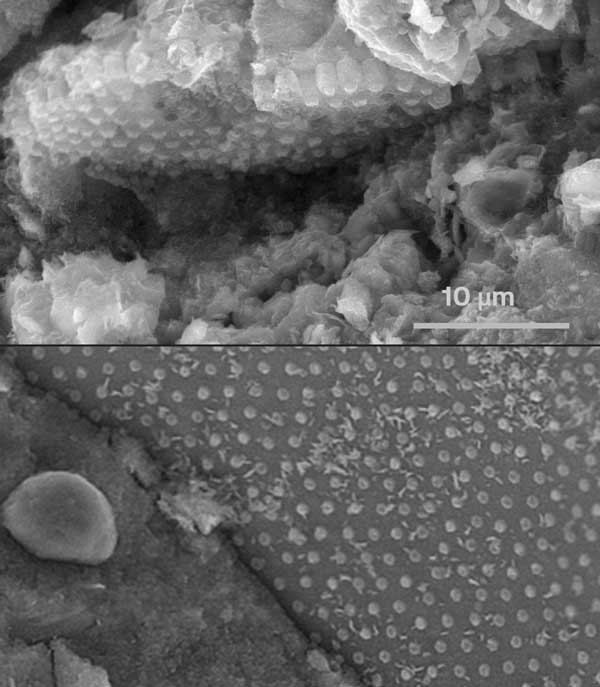
Mysterious structures: Electron microscope images of a polymetallic manganese nodule from the Pacific Ocean reveal patterns that are partly regular and partly irregular, resembling dots and honeycombs. Walter Geibert suspects that they were produced by colonies of microorganisms.
Radioactive Radiation Produces Hydrogen
Hydrogen could be a possible source of energy for the microorganisms. Only recently, colleagues of Geibert's identified a "deep biosphere" that extends far into the Earth's crust and whose life depends on minute quantities of hydrogen.
"Radioactivity must also be producing significant quantities of this life-sustaining substance within the manganese nodules. This is because radioactive rays break down water molecules into various fragments, including hydrogen — a process known as radiolysis," explains the researcher. "It's a complex process: some of the various molecular fragments react further to form other substances — depending on numerous parameters such as the pH value, the oxygen content of the environment, and even the pore size of the manganese nodules."
New Technology Reveals Radioactivity in Manganese Nodules
To shed more light on these complex processes, the appropriate equipment is required: for example, equipment capable of mapping the radioactive radiation. "To do this, we have adapted an X-ray visualisation technology. This means that, for the first time, we can now watch individual atoms in the nodules decaying in real time, visualise the resulting radioactive radiation and analyse the decay processes using software we have developed ourselves," he explains enthusiastically. "Images and videos showing spatially resolved alpha radiation — that is, radiation from positively charged helium-4 nuclei — didn't exist before!" This would mark the achievement of an initial milestone.
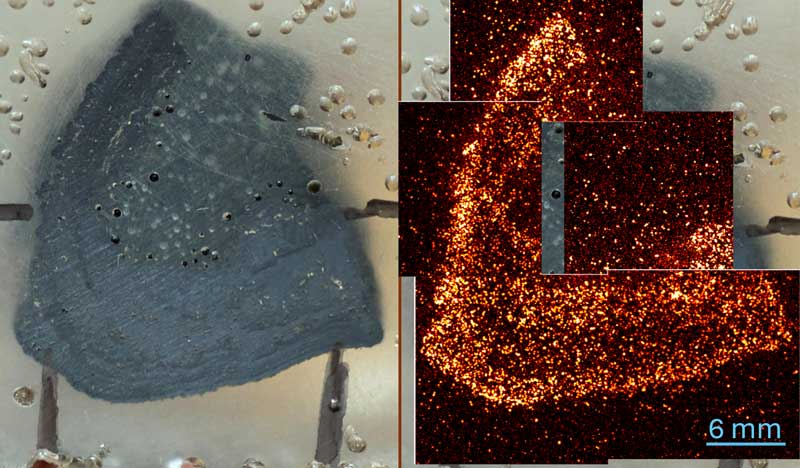
Using an innovative detector for spatially resolved digital radiation measurement, Geibert investigated the radioactivity of the manganese nodules. The brightness in the image to the right indicates the energy emitted by radioactive radiation — each bright spot corresponds to a single decay event. The larger spots are air bubbles that formed when the sample was poured into the container.
In the next step in his search for clues about the microorganisms and their means of survival, Geibert aims to find out exactly what happens inside the manganese nodules: where is radioactive radiation produced, and how much? How much energy does it have? And what quantities of hydrogen and other fragments of water molecules does it produce? The scientist is approaching the answers to these questions through experiments and calculations; these will later be integrated into a comprehensive model.
Perhaps the manganese nodules are even a kind of organism in their own right?
Extraterrestrial Life, Evolution and Life Itself
Micro-organisms in manganese nodules on the seabed are kilometres away from our everyday lives; they literally live in another world. Nevertheless, Geibert is certain that the results of his project could have a major impact on other areas of research, such as astrobiology. "The search for extraterrestrial life, for example, is currently limited to places where sunlight reaches. But if this theory is correct, living organisms could just as easily harness energy from radioactivity — and thus colonise places we have hitherto regarded as hostile to life," says Geibert.
The research also offers new insights into the early history of the Earth; after all, natural radioactivity was significantly higher back then than it is today. "At the same time, a great deal of evolution took place. It is entirely conceivable that radioactivity played a key role in the origin of life. Perhaps the manganese nodules are even a kind of organism in their own right?" muses Geibert. A provocative idea, and a new perspective on the very definition of life itself.





Editor-in-charge