In Brief

Momentum: €11.3 million for fresh ideas in the professorship

Frau mit Laptop in einem Heißluftballon, der durch Ventilatoren zusätzlichen Auftrieb erhält

Through its "Momentum" funding programme, the Foundation creates space for new ideas within the professorship. It supports initiatives that enable professors to further develop their research and teaching and to establish new areas of focus. Current projects include biodegradable plastics, AI-supported learning in schools, and the question of how public authorities can remain effective during crises.

In the day-to-day life of academia, there is rarely time to pause and strategically reorient one's professorship. This is precisely where "Momentum – Funding for Recently Tenured Professors" comes in: the programme is aimed at university professors three to five years after taking up their first tenured professorship and is open to all disciplines.

Important: "Momentum" does not fund individual research projects, but rather the overall development of a professorship. Depending on the project, this could include, for example, additional equipment, support from postdocs or student assistants, stays abroad, new teaching formats or science communication.

"We want to support professors at precisely the moment when they can truly shape their professorship – with time, resources and the backing to take risks," says Dr Selahattin Danisman, programme director at the Volkswagen Foundation. "We are particularly impressed when someone has the courage to rethink their own work and thereby give their field a tangible boost."

In this round of "Momentum", the Foundation has granted around €11.3 million for 12 new projects:

Stopping microplastics: biodegradable plastic

Plastics are everywhere – and they're a problem: they hardly break down naturally, but often disintegrate into microplastics that remain in the environment. Professor Wegner therefore wants to develop a new plastic material in which plastic-degrading enzymes are enclosed in tiny 'capsules'. As long as the plastic remains intact, the enzymes stay enclosed and inactive. Only when the plastic breaks down into microplastics and comes into contact with water do the capsules open: the enzymes become active and break down the plastic.

Project: Enzyme-Embedded Synthetic Cells enabling Environmental Self-Degradation of Microplastics (Prof. Dr. Seraphine Wegner, Universität Münster, approx. €940.000)

"Momentum" Funding Programme

"Momentum" refers to the decisive moment or is the English term for the physical quantity known as momentum. In this sense, this initiative is aimed at academics in the early stages of their first tenured professorship. The aim is to provide them with opportunities, at this stage of their career, to further develop their professorship in terms of both content and strategy.
Next deadlines: 14 April 2026 and 6 April 2027

About the funding initiative

AI in the classroom: learning that adapts to every child

Diverse school classes are becoming an increasing challenge for teachers. More and more often, pupils’ linguistic, cultural and socio-economic backgrounds determine their success in learning. Ideally, teaching approaches must adapt much more closely to individual needs than has been the case to date. AI, particularly large language models, is seen as an opportunity for personalised learning – yet its use in the classroom has been little researched. Professor Lachner combines educational research with AI, data science and machine learning. Together with partners from Germany and abroad, as well as with teachers, pupils and the Centre for School Quality and Teacher Training in Baden-Württemberg, he will develop new learning systems and test them in everyday practice.

Project: MATE: Machine Learning for Adaptive Teaching (Prof. Dr. Andreas Lachner, Universität Tübingen, approx. €950.000)

Wearables that learn as they go: real-time medical assistance

Medical wearables are portable devices such as sensor wristbands or patches that continuously measure vital signs – but are currently limited to data collection. To enhance the medical benefits of wearables, Professor Karlen aims to make them interactive: wearables deliver targeted stimuli, measure the response and adapt programmes to provide users with personalised medical support. To achieve this, Karlen is using the method of reinforcement learning: the system continuously learns through feedback and optimises itself. Karlen is starting by developing wearables that use sounds to influence sleep – this creates a great many opportunities every night for the system to learn. The results of his research could lead to personalised systems and new insights into bodily processes.

Project: Rethinking Medical Wearables (Prof. Dr. Walter Karlen, Universität Ulm, approx. €940.000)

Public authorities in a crisis: making better decisions through simulations

Public administration and administrative law typically focus on control, predictability and legal certainty. However, crises such as the COVID-19 pandemic or the effects of climate change, as well as the highly dynamic pace of technological change, present public authorities with new challenges: they must react more quickly and remain capable of acting, without reliable empirical data or precedents. Professor Wischmeyer will investigate how computer simulations and models can help ensure that public authorities remain capable of acting in crisis situations. To this end, he is working closely with practitioners in the public sector. By the end of the project, he aims to provide guidelines to enable public authorities to act proactively, flexibly and adaptively.

Project: Simulating Bureaucracy? The Uncertain Future of the Administrative State (Prof. Dr. Thomas Wischmeyer, Humboldt-Universität zu Berlin, approx. €940.000)

Portrait eines Mannes, dahinter Illustration mit Mikrofon

Room for development: Momentum funding for first-time professors

The 'Momentum - funding for recently tenured professors' initiative offers researchers the opportunity to further develop their professorship in terms of content and strategy at an early stage after taking up their first tenured full professorship. In our interview, Selahattin Danisman, program director at the Volkswagen Foundation, explains the key aspects of 'Momentum'. Next deadlines: 14 April 2026 and 6 April 2027

Learn more

Cells recreated: a gel demonstrates how they process forces

Cells can withstand pressure and tension and respond to them. However, this can only be studied to a limited extent, as cells are quickly damaged by invasive procedures. Biophysics professor Betz therefore aims to create a simplified replica of a cell’s interior: he combines tiny particles and plastics to form a gel that resembles cell plasma. He then applies specific forces, as in living cells, to test whether his models are accurate and how cells process stress. To this end, he is working closely with the Max Planck Institute for Dynamics and Self-Organisation.

Project: From Cells to Smart Gels: A Momentum in Motion (Prof. Dr. Timo Betz, Universität Göttingen, approx. €950.000)

Making dialects visible: preserving linguistic diversity

Dialects are being supplanted worldwide by more standardised regional languages. AI systems, too, are usually based on standard language and ignore dialects and regional linguistic differences. Prof. Bouzouita wants to change that. She uses online participatory projects to collect linguistic data on a large scale and is expanding her work on 'computer dialectology'. To this end, she combines dialect and social research with computer-assisted methods and integrates these into her teaching. In this way, she aims to better capture linguistic differences, for example by region or gender – and help ensure that linguistic diversity remains visible.

Project: Every Voice Matters: Scaling Dialectology with Computational Methods (Prof. Dr. Miriam Bouzouita, Humboldt-Universität zu Berlin, approx. €940.000)

Networking molecular machines: programmable and deformable materials

Prof. Dube is developing tiny "molecular machines" that can be altered by light, for example, thereby triggering reactions or generating movement. So far, these components have mostly operated in isolation from one another. In his project, the researcher aims to combine several such machines to build new, adaptable and recyclable materials. These are intended to change shape, perform tasks and even process simple information. Initial goals include flexible, light-switchable displays and materials that move and deform themselves. In the long term, this could lead to applications in sensors and robotics.

Project: From Molecular Machines to Precision Programmable Materials (Prof. Dr. Henry Dube, Friedrich-Alexander-Universität Erlangen-Nürnberg, approx. €940.000)

Magnetism in 3D: Understanding skyrmions, developing new magnets

Prof. Everschor-Sitte is researching skyrmions, tiny stable vortices in a magnetic field. In her project, she aims to take the next step towards 3D magnetism in her research and help improve our understanding of new 3D images of magnetic fields. To this end, she intends to develop models and algorithms to analyse experiments involving three-dimensional magnets. She is also building a 3D platform, with the support of a virtual reality developer, to visualise and ‘manipulate’ magnetic fields. In the long term, this is intended to enable the development of new, resource-efficient magnets.

Project: Next-Generation Magnets – the Future is 3D! (Prof. Dr. Karin Everschor-Sitte, Universität Duisburg-Essen, approx. €950.000)

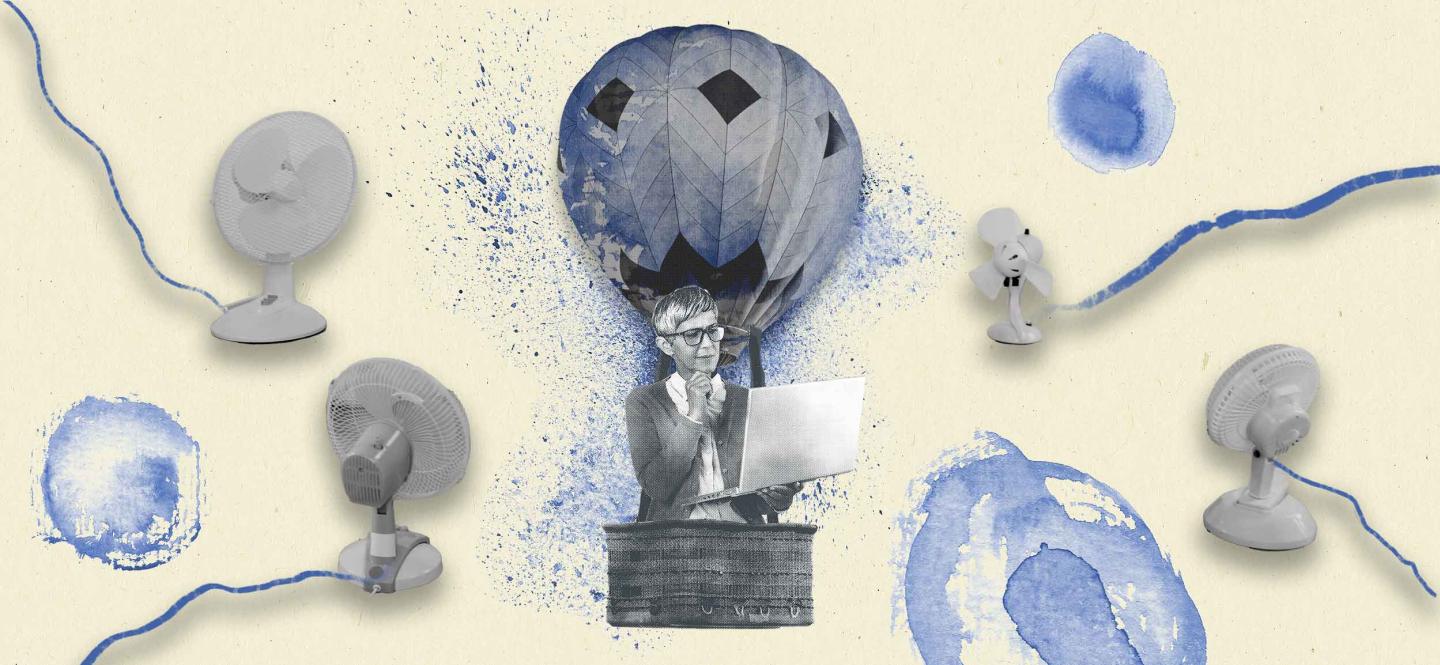
Frau mit Laptop in einem Heißluftballon, der durch Ventilatoren zusätzlichen Auftrieb erhält

9,7 Mio. für mutige Forschung mit "Momentum"

Mit der Förderinitiative "Momentum – Förderung für Erstberufene" unterstützt die VolkswagenStiftung Professor:innen in den ersten Jahren nach ihrer Berufung. Ziel ist es, ihnen Zeit und Mittel zu geben, um ihre Forschung weiterzuentwickeln oder sich mit neuen Themen zu beschäftigen.

Learn more

Training AI more efficiently: lower costs, lower CO₂ emissions

Training high-performance AI takes a lot of time, money and energy – and increases the carbon footprint. Prof. Potschka therefore aims to develop new training methods that make use of hidden, higher-dimensional structures in neural networks. These structures only become visible when the training problem is ‘elevated’ mathematically into a higher-dimensional space. This should make calculations simpler and more efficient. The researcher is developing and testing the methods and aims to put them into practice. He publishes the software, settings and results freely so that others can review and further develop them.

Project: Training algorithms with Lifted High-Rank Updates (LiftHighUp) (Prof. Dr. Andreas Potschka, Technische Universität Clausthal, approx. €940.000)

Magnetism under the microscope: measuring with diamond quantum sensors

Almost all materials are weakly magnetic. However, until now it has not been possible to visualise this weak magnetisation at micro- or nanometre resolution. Prof. Reinhard aims to develop a new measuring device for this purpose. It will utilise diamond quantum sensors that are highly sensitive to magnetic fields – even in the presence of strong background fields. He intends to use the device to investigate questions in solid-state physics, such as ageing processes in lithium batteries, defects in alloys and phase transitions in high-temperature superconductors.

Project: Ein Mikroskop für magnetische Suszeptibilität (Prof. Dr. Friedemann Reinhard, Universität Rostock, approx. €940.000)

Natural and Cultural History: What the Early Modern Period Teaches Us About the Anthropocene

In environmental history, there is a debate as to whether historical writing focuses too heavily on humans alone – particularly in the Anthropocene era. Prof. Schmidt-Funke aims to introduce a pre-industrial perspective on this issue and establish her chair as a centre for 'nature-culture' history. She seeks to demonstrate how, in the early modern period, seemingly contradictory phenomena coexisted – such as the exploitation and conservation of resources, or the domination and veneration of nature. To this end, she combines several historical approaches and, through teacher training in Leipzig, brings the findings into schools.

Project: Towards a natural-cultural history of the early modern period (Prof. Dr. Julia A. Schmidt-Funke, Universität Leipzig, approx. €940.000)

Immunity and gender: New animal models for better medicine

Immune systems differ between the sexes – and as a result, the course of diseases and treatments often differ too. However, these connections have not yet been thoroughly researched, particularly with regard to women and non-binary people. Prof. Roth aims to develop new animal models for this purpose. She is studying species with unusual reproductive behaviours, such as pipefish and seahorses, in which the males are 'pregnant', or fish that change sex. In her project, she aims to identify species that are well-suited for experimental use and establish them as new model systems. In doing so, she hopes to gain a better understanding of how the immune system and reproduction develop in tandem – and thus contribute to more inclusive medicine in the long term.

Project: New model systems to unravel the coevolution of reproductive strategy & immunity (Prof. Dr. Olivia Roth, Universität Kiel, approx. €950.000)

Further information on the Volkswagen Foundation's "Momentum – Funding for Newly Appointed Academics" programme.

Frau mit Laptop in der Hand steht im Heißluftballon

Momentum: Zeit für Veränderung

Die eigene Professur inhaltlich und strategisch weiterentwickeln, diese Möglichkeit erhalten dreizehn Professor:innen in den kommenden vier Jahren im Rahmen der Momentum-Förderung. Wie themenoffen das Angebot ist, zeigen ausgewählte Ideen der Geförderten.

Learn more